Why Project and Portfolio Management Is No Longer Optional for Construction Companies
An Industry Built on Complexity
Few industries juggle as many moving parts at once as construction. A single project can span land acquisition, permitting, design, procurement, on-site execution, subcontractor coordination, and post-completion handover — each stage generating its own paperwork, budget lines, risks, and approvals. Multiply that across a portfolio of active sites, subsidiaries, and construction types (residential, industrial, commercial), and it's easy to see why so many construction firms still run on spreadsheets, email threads, and whoever remembers to make the follow-up call.
That approach works until it doesn't. Cost overruns, permit delays, material shortages, and disputes over change orders are rarely caused by a single bad decision — they're usually the result of information that existed somewhere in the organization but wasn't visible to the person who needed it in time. Project and Portfolio Management (PPM) exists to close that gap.
What PPM Actually Covers in Construction
PPM isn't a single tool or a single discipline — it spans three connected levels of visibility:
- Portfolio and investment prioritization — deciding which projects and proposals deserve funding and engineering capacity, running "what if" scenarios, and optimizing investment across the whole pipeline.
- Integrated project delivery — managing everything from the initial idea or proposal through resourcing, financial tracking, and benefits realization once the asset is delivered.
- A single source of truth across platforms — connecting PPM data with financial systems (SAP, Oracle, JDE) and giving different stakeholders — executives, site managers, finance teams — the views they actually need through custom reports, dashboards, and persona-based access.
For a construction organization managing multiple accounts, subsidiaries, and property types, this structure maps directly onto how the business actually operates: a portfolio (say, residential vs. industrial construction), broken into programs (individual subsidiaries or execution vehicles), broken into projects (a specific building or property), each moving through the same underlying lifecycle — identification, pre-construction, procurement, construction, commissioning, and closeout.
The Construction Lifecycle Deserves Its Own Lens
Generic project management tools often fail in construction because construction has its own rhythm. A typical lifecycle runs through:
- Project identification — awarded bids, initial designs, feasibility assessment.
- Pre-construction — permits, licenses, land or right-of-way acquisition, site assessment, and planning.
- Procurement — material and equipment requests, change orders, labor requests, and vendor management.
- Construction — implementation, timeline monitoring, and cost tracking.
- Commissioning and occupancy — punch lists, testing and turnover, quality assurance, and business permits.
- Project closeout — post-project review and after-sales service.
Each of these stages produces data that the next stage depends on. When that data lives in disconnected spreadsheets and inboxes instead of a shared system, delays compound — a missed permit renewal shows up as a stalled construction schedule three months later, and nobody can trace why.
Where PPM Pays for Itself: Financial and Materials Control
Two of the most expensive risk areas in any construction project are budget control and materials management — and they're also where PPM delivers some of its clearest value.
Budget tracking down to the scope of work. A well-implemented PPM system displays the budget for every scope of work — civil, electrical, mechanical, and so on — with access controls so only authorized departments see cost details, while still allowing details to be exported for broader reporting. Paired with progress reports fed in by on-site personnel, this gives teams a live view of budget versus actuals, not a reconciliation exercise done weeks after the fact.
Materials visibility from request to delivery. A comprehensive bill of materials, tied to each scope of work, means procurement isn't guessing what's needed and when. Material requests can be tracked through every status — requested, received, processed, delivered, received on site, withdrawn — closing the loop between what was ordered and what actually shows up.
Permits as a tracked asset, not a filing cabinet. Pre-construction and pre-operation permits are notorious for quietly stalling projects. Displaying every permit's status, owner, cost, and estimated completion date on a shared dashboard turns permitting from a background risk into something actively monitored.
Sub-projects that still roll up to the whole. Departments — design, visual merchandising, engineering — often need their own timelines and approval workflows. PPM allows these sub-projects to run independently while still feeding into the master project view, so the organization gets granular ownership without losing the big picture.
The Business Value: Why This Matters Beyond the Site Office
The case for PPM in construction comes down to a handful of concrete outcomes:
- Accurate reporting and faster decisions. Leadership can make informed calls quickly instead of waiting for the next status meeting.
- Real-time data. Operational efficiency comes from tracking and monitoring performance as it happens, not after the fact.
- Better resource management. Capacity planning and allocation decisions are based on actual demand flowing through the investment pipeline, not guesswork.
- Investment in the right projects. Proposals get prioritized against standardized, organization-wide criteria instead of politics or urgency.
- Processes that reflect how work actually happens on the ground. Logical, trackable progression instead of disconnected updates.
- Stronger financial management. Standardized reporting and real-time updates on spend across every project.
These translate into measurable benefits: reduced manual effort and lower labor costs from automation, faster on-time decision-making from real-time visibility into tasks and risks, stronger governance through built-in audit trails for decisions and access changes, and better resource planning through live reporting tied to actual project demand. It also frees the workforce to focus on higher-value work instead of manual, labor-intensive tracking — and opens the door to further digital and AI-driven capabilities as the organization matures.
A Portfolio View That Actually Prevents Conflicts
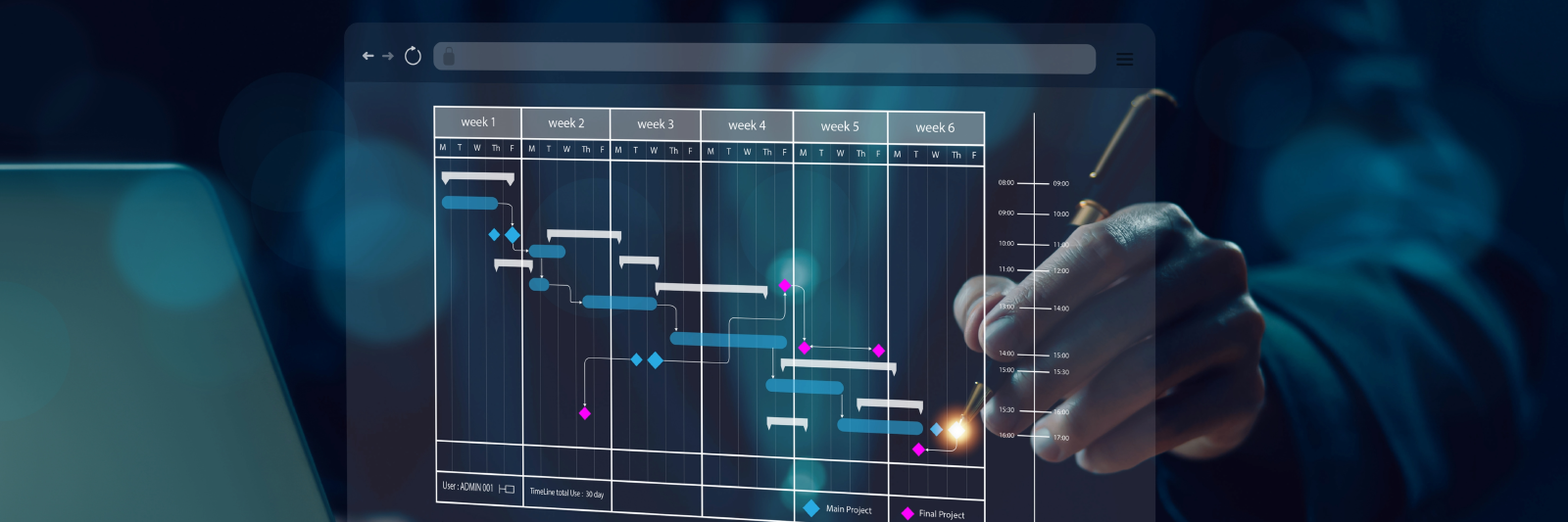
One of the most underrated benefits of mature PPM in construction is simply being able to see every project on a single timeline. When a firm is running multiple depots, sites, or developments simultaneously, resourcing conflicts and scheduling collisions are inevitable — but only a problem if they go unnoticed until it's too late. A consolidated project timeline, paired with real-time monitoring across proposals, ongoing projects, and completed work, lets leadership catch and resolve conflicts before they interfere with organizational goals, rather than discovering them mid-build.
Key Takeaways
- Construction's complexity — multiple stages, subcontractors, permits, and budgets across many simultaneous projects — makes ad hoc tracking a liability, not a shortcut.
- PPM maps naturally onto how construction firms are already structured: portfolios, programs, and projects, each moving through a shared lifecycle from identification to closeout.
- The highest-value areas for PPM are the ones with the most financial exposure: budget-to-actuals tracking, materials and procurement visibility, and permit monitoring.
- A single source of truth — connected to financial systems and tailored to different stakeholders — turns fragmented reporting into real-time, decision-ready visibility.
- The payoff isn't just efficiency: it's fewer scheduling conflicts, stronger governance, better resource planning, and a workforce freed up to focus on higher-value work.
If you're exploring how to bring this level of visibility and control to your construction projects, SPMview Technologies offers Project and Portfolio Management Solutions built for the construction industry — explore their services at spmview.com/services, or download their PPM brochure to see how the platform supports budget tracking, materials management, permit monitoring, and portfolio-wide visibility.